


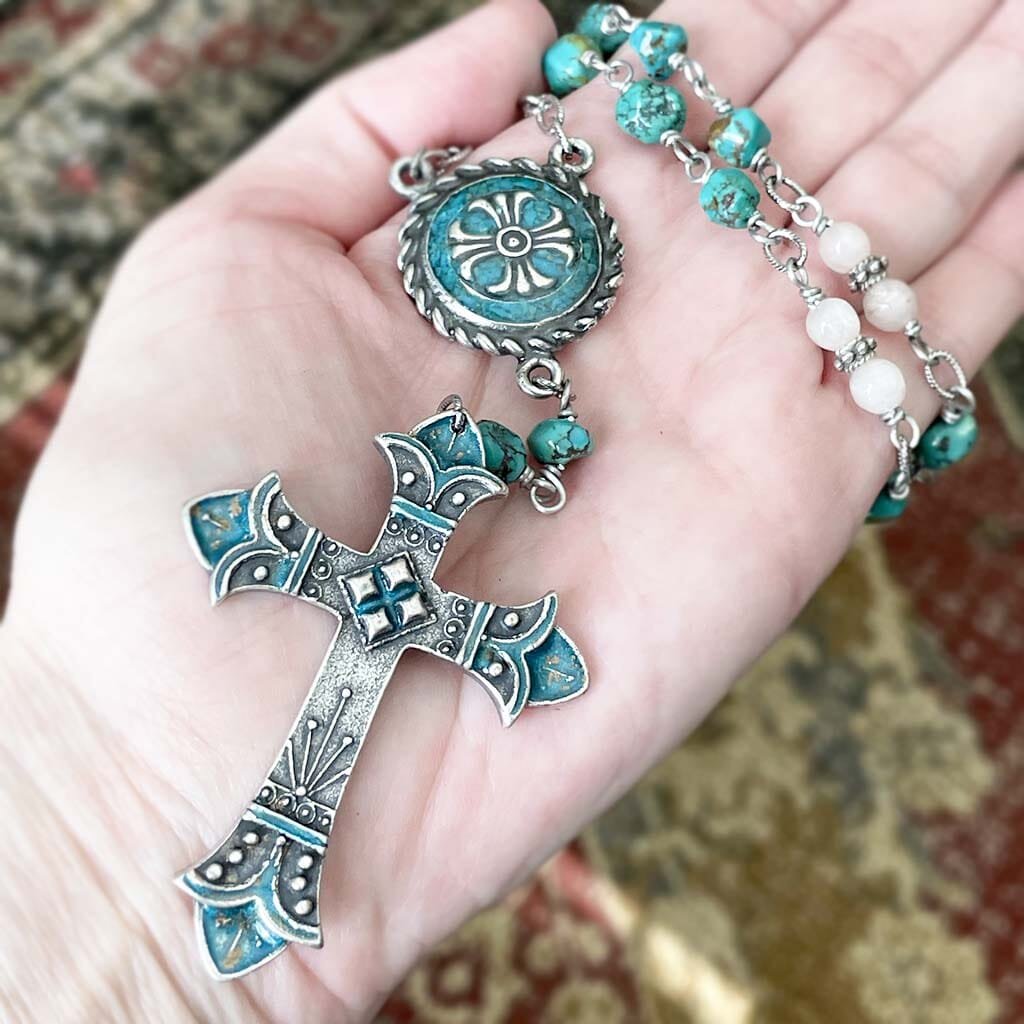
To the historian, the crucifix is a paradox. For the first 300 years of Christianity, it was rarely depicted in art. It was, after all, a tool of state-sponsored torture—the Roman equivalent of an electric chair. It was a symbol of shame, suffering, and political execution.
Yet, walk down the street of any major city today, or scroll through the Instagram feed of a trap artist or a rock star, and you will see this geometric shape everywhere. It hangs against bare chests, it dangles from earlobes, and it is printed on denim jackets.
Somewhere along the timeline of history, the ultimate symbol of suffering became the ultimate symbol of cool. But how did the most sacred icon of the Church end up in the smoke-filled dive bars of 1980s London and the VIP sections of 90s Los Angeles?
The answer lies in the intersection of rebellion, protection, and the “tortured artist.”
The 1980s: The Great Subversion
If you want to understand modern jewelry trends, you have to look at the Punk movement.
Before the late 1970s, wearing religious iconography was largely a sincere act of faith. You wore it because you went to Mass. It was small, modest, and tucked under the shirt.
Then came the Punks. Figures like Billy Idol and Sex Pistols fans began raiding the thrift stores and church bins. They draped themselves in rosaries. They wore oversized, ornate pendants.
For the Punks, this wasn’t about piety; it was about subversion. The logic was visual irony. The punk ethos was about rejecting authority, and the Church was the ultimate authority. By taking a sacred object and wearing it with ripped leather, safety pins, and aggressive makeup, they were stripping the symbol of its “holiness” and claiming it as a symbol of their own suffering. They were saying, “We are the outcasts, the persecuted, the martyrs of the modern age.”
Madonna took this mainstream. When she rolled around on stage in a wedding dress covered in crucifixes, she collapsed the distance between the Sacred and the Profane. She made the symbol sexy. Suddenly, the pendant wasn’t just for the devout; it was for the daring.
The Hip-Hop “Jesus Piece”
While Punks were using the symbol for irony, Hip-Hop culture in the 1990s adopted it for a completely different reason: Survival.
In the dangerous ecosystem of 90s New York and Los Angeles, the “Jesus Piece” (a trend popularized by The Notorious B.I.G.) became a staple. These weren’t the modest silver items of the past; these were massive, solid gold, diamond-encrusted faces of Jesus or heavy distinct geometric symbols.
This wasn’t irony. It was a complex mix of guilt, gratitude, and protection.
For many rappers coming from poverty and entering a life of high-risk success, the symbol served two purposes:
- The Flex: It was a display of wealth. To afford a solid gold chain meant you had “made it.”
- The Shield: It was a talisman. In a life where violence was a daily possibility, wearing the symbol was a way of asking for divine cover. It was a public acknowledgment that despite the sins of the street, the wearer still answered to a higher power.
This era cemented the “heavy” aesthetic. It established the rule that masculine jewelry should have weight. It should feel like armor.
The Modern Meaning: Conviction Over Creed
Today, the symbol has evolved again. It has settled into a space that is less about shock value (punk) and less about overt flash (90s hip-hop), and more about conviction.
We see secular celebrities and athletes wearing them. We see high-fashion houses like Dolce & Gabbana sending them down the runway.
For the modern man, the shape has become an archetype. It represents a “burden” or a “cause.” The vertical line represents the connection to the divine or the higher self; the horizontal line represents the connection to the world and humanity. Even for the non-religious, it is a grounding totem. It represents the idea of standing for something, of sacrificing for something.
The Aesthetic of the Vertical
From a purely stylistic perspective, the enduring popularity of this shape comes down to geometry.
Men’s fashion is often boxy. T-shirts are square; blazers are rectangular. A pendant that drops to the center of the chest creates a “V” shape. It breaks up the monotony of the torso. It draws the eye to the center line, creating a visual symmetry that is pleasing to the human brain.
Whether it is a rugged, hammered-steel piece worn on a leather cord (the “surfer/rocker” vibe) or a clean, gold piece worn over a black turtleneck (the “creative director” vibe), the accessory does the heavy lifting of the outfit.
Conclusion
The journey of this symbol is one of the strangest in human history. It survived the fall of Rome, the Crusades, the Reformation, and the mosh pits of CBGB.
It persists because it is versatile. It can be a quiet whisper of faith for one man and a loud shout of rebellion for another. It can be a grandmother’s heirloom or a rapper’s trophy.
When we look at the modern landscape of mens crosses, we aren’t just looking at metal. We are looking at a collision of history. We are seeing an artifact that has been constantly reinvented by the people who needed it most—from the saints who needed hope, to the punks who needed a voice, to the modern man who just needs something solid to hold on to in a shifting world.
