


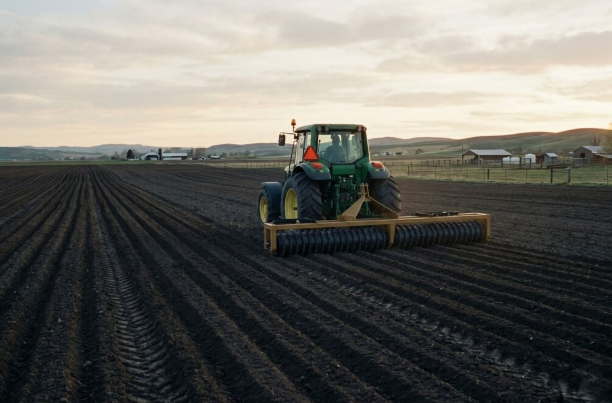
There is a particular kind of film scene that signals a director understands farming without needing to explain it — a cultipacker moving across a field in early spring, ribbed rollers pressing newly worked soil into something firm and ready. No dialogue, no close-up. Just equipment doing what it does before anything visible happens. For filmmakers working in rural settings, that kind of detail is currency. It tells audiences who know farming that the production paid attention, and it tells those who don’t that something important and unhurried is underway.
This article examines how agricultural equipment — the cultipacker in particular — functions in visual storytelling, how the tool’s design connects to its cultural representation, and what its various forms reveal about the breadth of modern farming practice.
The Evolution of Soil Preparation Technology
Modern agriculture emerged from centuries of incremental innovation in soil management. Early farmers worked with drag harrows and wooden rollers — tools that left uneven surfaces, compromised germination rates, and demanded repeated passes across the same ground. The cultipacker evolved as a direct response to that problem: a tool designed to break soil clods and firm the seedbed in a single operation, creating the consistent soil contact that seeds need to absorb moisture and establish roots.
By the mid-20th century, manufacturers had refined cultipacker designs considerably — adjustable weight systems, varied roller configurations, materials that held up across seasons of heavy use. These refinements allowed farmers to match soil compaction to specific crop requirements, moisture levels, and soil composition. The improvement to germination rates was significant enough that the cultipacker became standard practice across diverse farming operations — from large commercial row cropping to small-scale pasture seeding where every seed dollar counts. The tool’s persistence in contemporary agriculture comes down to a straightforward fact: it solves a problem that hasn’t changed. Seeds still need firm, consistent contact with soil particles. Loose, uneven surfaces still compromise germination. The cultipacker addresses both without over-complicating the process.
Functional Design and Its Practical Impact
The cultipacker’s effectiveness comes from its combination of weight and surface geometry. Heavy ribbed rollers press into freshly worked soil simultaneously breaking clods and creating a firm, textured surface — the corrugated pattern that results manages water flow, prevents surface crusting, and creates the capillary action that draws moisture upward toward germinating seeds. Moisture conservation is a primary outcome; compacted soil reduces evaporation by eliminating large air pockets while maintaining the upward movement of water from deeper layers. SARE’s soil management research confirms that secondary tillage tools like roller-packers create the uniform, finely aggregated seedbeds that give seeds the consistent moisture access they need during the critical germination window.
Agricultural Authenticity in Visual Media
When cultipackers appear in film and television, they signal something specific to audiences who know the land. Unlike combines or tractors that anchor harvest scenes, the cultipacker operates in the quieter, preparatory phase of the farming calendar — the work that happens before growth becomes visible. Production designers and location scouts who use it correctly in establishing shots or transitional sequences are telling viewers that the characters onscreen are engaged in the foundational work of the season, not simply moving through a pastoral backdrop.
Several independent films set in farming communities have used cultipackers this way — not to drive plot, but to establish credibility. The detail matters because agricultural audiences notice when equipment doesn’t match the task or the season. A cultipacker in a spring field sequence communicates planting preparation with more precision than any line of dialogue. Documentary filmmakers have picked up on this quality too, occasionally using the tool’s rhythmic, methodical motion to underscore narration about patience or the long view required in both farming and land stewardship. The firm, level surface ensures seeds rest at consistent depths, leading to synchronized emergence — particularly important for small-seeded crops like alfalfa and clover where even small variations in depth affect germination timing. Seeds pressed firmly against soil particles absorb water and nutrients more efficiently during germination. Iowa State University Extension agronomists recommend cultipacking as the final seedbed preparation step for small-seeded crops precisely because of how directly seed-to-soil contact controls emergence success.
Specialized Cultipacker Configurations
Modern agriculture has produced several cultipacker variants, each addressing specific conditions and operation scales:
- Cultipacker Seeder Combinations: Integrated units that plant and firm soil in a single pass, reducing fuel costs and the number of trips across fields. The synchronized operation ensures seeds receive immediate soil contact — valuable when weather windows for planting are narrow.
- Pull-Behind Models: Versatile attachments for tractors and ATVs that suit operations ranging from large commercial farms to smaller food plot management. Their adjustable hitch systems allow matching to available power sources without requiring dedicated equipment.
- Water-Filled Designs: Operators adjust roller weight by adding or removing water — lighter for sandy soils prone to over-compaction, heavier for clay soils requiring more pressure to break clods effectively. This adaptability makes water-filled cultipackers particularly practical for farms managing diverse soil types across a single property.
Contemporary Applications Across Farming Contexts
In conservation tillage systems, cultipackers help manage residue and create seed slots without requiring full tillage that would compromise soil structure. Cover crop establishment benefits similarly — successful establishment of cover crop mixes depends on seed-to-soil contact that harrows alone rarely achieve consistently. Pasture renovation presents another application: overseeding existing pastures with a cultipacker allows new seed to contact soil without destroying the ground cover that holds the pasture together during transition. For operations evaluating equipment in this category, manufacturers including Ranew’s Outdoor Equipment, Packer Maxx, and Plotmaster Systems have developed purpose-built configurations for food plot and wildlife habitat work — a segment of the market that has grown significantly.
The cultipacker’s value extends well beyond conventional row cropping. Wildlife managers and hunters establishing food plots have adopted compact cultipacker designs specifically suited to irregular terrain and smaller plot sizes — ground where larger agricultural equipment cannot operate without damage to surrounding areas. The precision seedbed these tools create is especially valuable for food plot seeding, where seed costs are high, and planting windows are narrow.
What the Cultipacker Reveals About Agricultural Practice
Farming is full of tools that do essential work invisibly. The cultipacker is one of the clearest examples — operating in the gap between tillage and planting, creating conditions that determine whether expensive seed investments succeed or fail, leaving no trace of its work once the crop emerges. That invisibility is precisely what makes it useful as a storytelling device in film: its presence signals preparation, care, and the kind of knowledge that doesn’t announce itself.
Its various forms — seeder combinations, pull-behind models, water-filled configurations for variable soil types — reflect the practical diversity of farming itself. Different soils, different crops, different scales of operation all create different requirements, and the cultipacker has adapted to meet them across a century of agricultural change. The tool persists because the problem it solves persists: seeds need firm ground, and firm ground takes work to create.
