


The craft beer revolution is built on a spectrum of scale. At one end, you have the passionate artisan operating a “nanobrewery,” often tucked into a garage or a small storefront, producing beer in tiny batches for a hyper-local audience. At the other end is the “microbrewery,” a production-focused facility that distributes across regions and operates with industrial-grade efficiency.
While both types of breweries share the goal of making great beer, the equipment requirements, operational philosophies, and capital investments are worlds apart. Choosing the right scale is the most critical decision an entrepreneur will make, as it dictates everything from the plumbing requirements to the potential for profit. This guide provides a deep dive into the technical and equipment-based differences between nanobrewery and microbrewery operations.
Defining the Scale: Nano vs. Micro
Before diving into the hardware, we must define the parameters.
- Nanobrewery: Typically defined as a brewery that produces beer in batches of 3 barrels (BBL) or less. A barrel in the United States is equivalent to 31 gallons. Nanobreweries are often “taproom-only” models, where the high margins of retail sales compensate for the labor-intensive nature of small-batch brewing.
- Microbrewery: According to the Brewers Association, a microbrewery produces fewer than 15,000 barrels per year, with at least 75% of its beer sold off-site. In terms of equipment, this usually starts at the 7BBL to 10BBL range and can go up to 30BBL or 60BBL systems.
1. Brewhouse Configurations: Simplicity vs. Throughput
The brewhouse is the heart of the operation, but its complexity scales with its volume.
The Nanobrewery Brewhouse (1BBL – 3BBL)
In a nanobrewery, space and budget are usually the primary constraints.
- Vessel Design: Many nanobreweries use “all-in-one” systems or 2-vessel configurations (Mash/Lauter Tun and Kettle/Whirlpool).
- Heating Source: Electricity is the king of the nanobrewery. Large electric immersion elements or induction plates are common because they don’t require the expensive venting or gas lines associated with burners.
- Manifolds and Piping: Nanobreweries often rely on flexible, food-grade hoses and manual tri-clamp connections rather than hard-piped stainless steel. This allows the brewer to move hoses between pumps and vessels as needed, saving on the cost of permanent valves and piping.
The Microbrewery Brewhouse (7BBL – 30BBL+)
Once you cross the 7BBL threshold, efficiency becomes the priority.
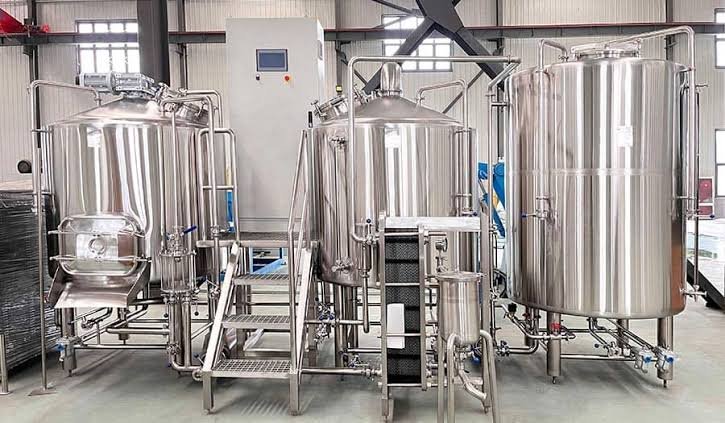
- 3 and 4-Vessel Systems: To increase throughput, microbreweries use dedicated vessels: a Mash Tun, a Lauter Tun with a motorized rake system, a Brew Kettle, and a dedicated Whirlpool. This allows the brewer to start a second batch while the first is still boiling.
- Heating Source: Steam is the professional standard here. A steam boiler provides fast, even heating via jackets on the outside of the kettles, preventing the “scorching” of wort that can happen with direct-fire or electric elements.
- Hard Piping and Automation: Microbreweries are often hard-piped with stainless steel and managed via a central PLC (Programmable Logic Controller) touchscreen. This ensures consistency across hundreds of batches.
2. Fermentation and Cellar Management
The “cold side” is where the most significant physical space is consumed.
Nano-Cellar Requirements
- Plastic vs. Steel: While some nanobreweries start with heavy-duty plastic fermenters, most professional operations quickly move to small stainless steel unitanks.
- Cooling: Nanobreweries often use “chiller coils” submerged in the beer or small, portable glycol chillers. In some cases, brewers use “ferm-wraps” (electric heating pads) and chest refrigerators (kegerators) to control temperatures.
- Unitanks: Even at 1BBL, a unitank is preferred because it allows the brewer to ferment and carbonate in the same vessel, which is vital when space for a separate “Brite” tank is unavailable.
Micro-Cellar Requirements
- Jacketed Unitanks: Every tank in a microbrewery is “jacketed,” meaning it has a double wall through which chilled glycol circulates. This is controlled by automated solenoid valves connected to a central thermostat.
- Volume Ratios: Microbreweries often employ “double-sized” fermenters. For example, a 10BBL brewhouse might feed 20BBL or 40BBL fermenters. This maximizes floor space and reduces the number of tanks that need to be cleaned.
- Brite Tanks (BBTs): Unlike the nano-model, microbreweries almost always use dedicated Brite tanks for clarification and carbonation. This frees up the fermentation tanks to start the next batch immediately, increasing the brewery’s total annual capacity.
3. The Utility Gap: Power, Water, and Waste
The most overlooked difference between these two scales is the infrastructure required to support the tanks.
Nanobrewery Infrastructure
A nanobrewery can often operate in a light-commercial or even a residential-style space with minor upgrades.
- Water: Standard municipal water pressure is usually sufficient.
- Drainage: Many nanobreweries use “hub drains” or even heavy-duty sump pumps if floor drains aren’t available.
- Power: Typically requires 240V single-phase power, which is standard in most commercial buildings.
Microbrewery Infrastructure
A microbrewery is a heavy industrial operation.
- The Slab: You cannot put 30BBL tanks on a standard 4-inch concrete floor. Microbreweries require reinforced concrete slabs (6 inches or more) and specialized urethane coatings to withstand the weight and the chemicals.
- Trench Drains: Large-scale brewing involves moving hundreds of gallons of water during “knock-out” and cleaning. Stainless steel trench drains are a necessity.
- 3-Phase Power: Industrial pumps, grain mills, and large glycol chillers require 3-phase power. If the building doesn’t have it, the cost to bring it in from the street can be tens of thousands of dollars.
4. Grain Handling and Milling
The sheer volume of malt required changes the equipment needs drastically.
- Nanobrewery: The brewer might buy 55-lb bags of malt, store them on a few pallets, and use a small, manual or drill-powered 2-roll mill. The crushed grain is usually carried by hand in buckets to the mash tun.
- Microbrewery: Efficiency dictates buying grain in bulk. This requires grain silos (outside the building) or “Super Sacks.” A motorized auger system is required to transport the grain from the mill to a grist hopper situated above the mash tun. This prevents physical strain and controls grain dust, which is a major fire and health hazard.
5. Packaging and Quality Control
How the beer leaves the building is the final major equipment differentiator.
Nano-Packaging
Most nanobreweries sell 90% of their beer across their own bar.
- Kegging: A simple manual keg washer and a small fleet of kegs are sufficient.
- Canning: If they can at all, they often use manual “bench-top” canners that seal one can at a time, or they rely on “crowlers” (32oz cans filled from the tap).
Micro-Packaging
Microbreweries live or die by their shelf presence.
- Automated Canning Lines: These lines purge oxygen, fill, and seam cans at rates of 30 to 100+ cans per minute.
- Dissolved Oxygen (DO) Meters: High-end sensors are used to ensure that oxygen levels are kept to a minimum, preserving the beer’s shelf life.
- Lab Equipment: Microbreweries require a basic lab with a microscope, pH meters, and forced-aging incubators to ensure every batch sent to distribution is shelf-stable and consistent.
6. Cleaning and Sanitation (CIP)
Sanitation is the non-negotiable part of brewing, but the method changes with scale.
- Nano-Cleaning: Often involves manual scrubbing or “recirculating” chemicals using a small portable pump. Because the tanks are small, the brewer can often see every corner of the interior.
- Micro-Cleaning: Relies entirely on Clean-In-Place (CIP) skids. These are mobile units with heaters and high-pressure pumps that circulate caustic and acid through “spray balls” inside the tanks. At this scale, the tanks are too large to scrub manually, so the mechanical force of the spray ball is what ensures a sterile environment.
Summary Comparison Table
Feature Nanobrewery (1-3 BBL) Microbrewery (7-30+ BBL) Primary Goal Artisan/Taproom focused Production/Distribution focused Heat Source Electric (Internal elements) Steam (External boiler) Grain Handling Manual / Bags Automated Augers / Silos Cooling Small glycol units / Wraps Large-scale 3-phase glycol chillers Flooring Standard/Modified concrete Reinforced slab with trench drains Packaging Draft/Crowlers High-speed canning/bottling Labor High labor per gallon High efficiency per gallon
Elevate Your Vision with Micet
Whether you are dreaming of a cozy 2BBL nanobrewery or a 20BBL production microbrewery, the quality of your stainless steel is the foundation of your success. Micet is a global leader in the manufacturing of high-performance brewing equipment, offering customized solutions for every scale of craft beer production.
Micet’s equipment is engineered for longevity and precision. Our products feature:
- Certified 304/316L Stainless Steel: For maximum corrosion resistance and hygiene.
- Precision TIG Welding: Ensuring smooth, sanitary seams that prevent bacterial growth.
- Tailored Engineering: From compact, electric nanobrewery “turnkey” kits to fully automated, steam-jacketed microbrewery systems.
- Global Support: Micet provides comprehensive layout planning, installation guidance, and dedicated after-sales service to ensure your brewery hits the ground running.
By choosing Micet, you are investing in equipment that grows with you, providing the consistency and reliability that professional brewers demand.
Frequently Asked Questions
1. Is it possible to scale a nanobrewery into a microbrewery later?
Yes, but it requires planning. If you start as a nanobrewery, ensure your building has the ceiling height and floor drainage to support larger tanks in the future. Many brewers start with a 3BBL brewhouse but install 7BBL or 10BBL fermentation tanks later, using “double-batches” to fill the larger vessels.
2. Why is steam heating better for larger systems?
Steam is much more efficient at transferring heat across large surface areas. In a 20BBL kettle, an electric element would struggle to maintain a vigorous boil, and direct fire can cause “hot spots” that caramelize the sugars (scorching). Steam jackets provide a gentle, even heat that preserves the delicate flavors of the malt.
3. Which scale is more profitable?
It depends on the business model. Nanobreweries have higher margins because they sell directly to consumers at $7 a pint. However, they are limited by the number of seats in their taproom. Microbreweries have lower margins per pint because they sell to wholesalers, but they make up for it with high-volume sales. Most successful modern breweries utilize a “hybrid” model: a 10BBL system that services a busy taproom while also distributing cans to local stores.
