


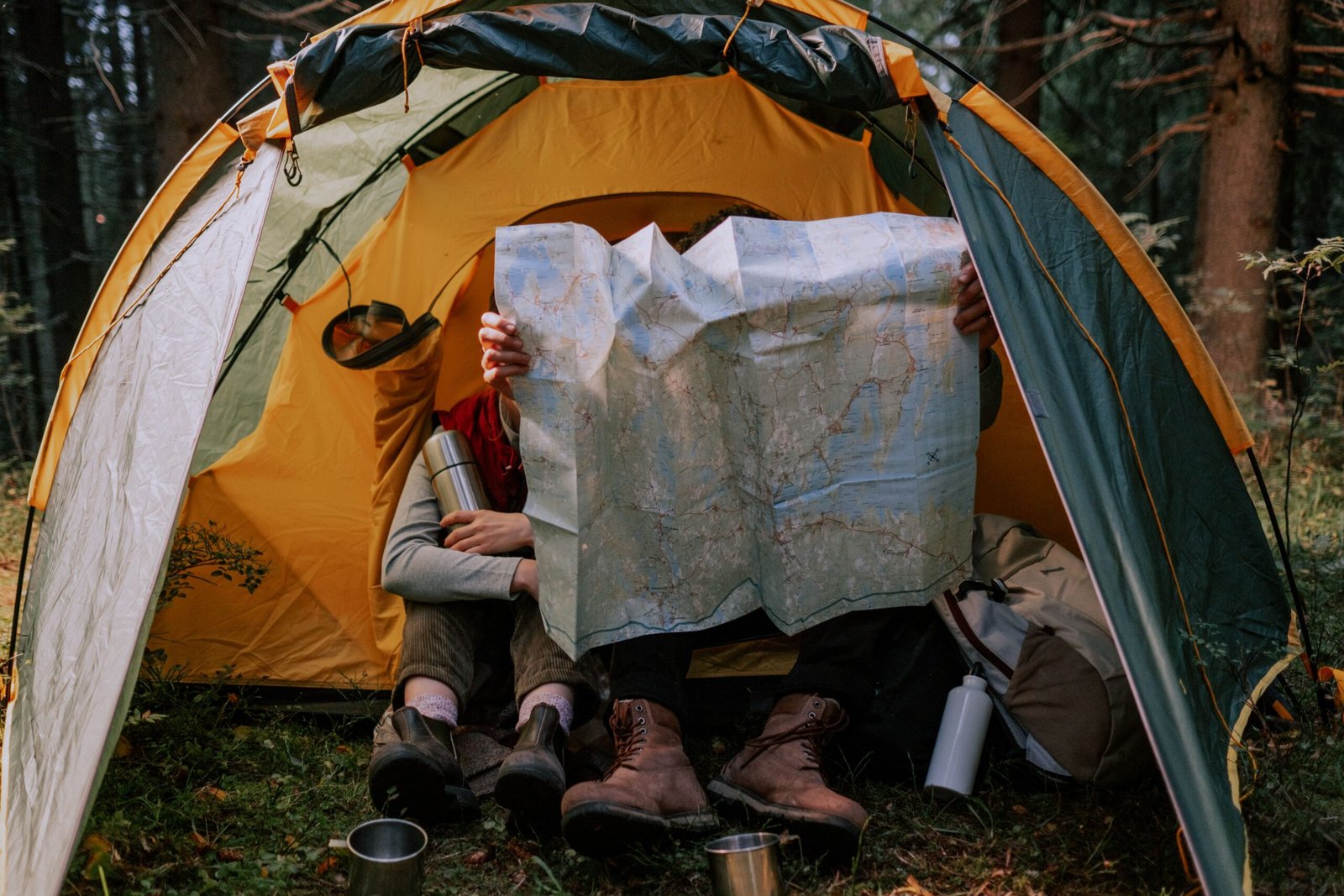
A camping trip may be ruined not because of the storm, but because of the choices that were made before it happened – choosing a camping spot without considering drainage, using stakes that were considered “satisfactory”, or not positioning the tarp appropriately. Harsh weather can be survived if you’re properly prepared.
What really ruins a trip, and sometimes leads to casualties, is neglecting weather preparation and not going through a specific checklist before each trip.
Read The Terrain Before You Read The Forecast
Predictions could be helpful, but they shouldn’t be your first step. Forecasts can be inaccurate by hours or miles, and a storm cell forming over a ridge line ten kilometers away can still push a wall of water through your camp faster than you can react. Terrain doesn’t tell lies as forecasts might.
When you’re checking a location, observe what the Earth is showing you. Dry creek beds, washes, and low points that appear as flat, convenient tent pads are usually acting as drainage channels. Flash floods can be devastating because rain falling far upstream, sometimes well out of your eyesight and earshot, can transform dry gullies into rushing torrents within minutes. If you see any indication of water having passed through an area like smoothed rocks, sediment lines, or stripped vegetation, that location is not an option despite how flat and attractive it appears.
What’s above you is equally important as what’s under your feet. Widowmakers such as large dead limbs or entire trees weakened by rot or prior storm harm can fall without any notice, storm or no storm. Check for cracked bark, hanging limbs, and trees leaning at odd angles prior to setting up anything underneath them. A lot of campers search the ground for the ideal spot and barely look up.
High ground with a built-in windbreak such as a rock formation, dense treeline, or non-flood zone slope is better than a scenic flat clearing whenever the conditions get rough. This is the most important choice you’ll need to make on your journey, and you’ve to make it before you even start setting up your tent.
Build A Real Weather Picture, Not Just A Glance At An App
A quick look at a weather app tells you nothing good. What counts are the trends developing over the course of hours, not what picture is on your screen right now.
Monitor forecasts a few times daily, not once over coffee. Watch the sky above you – towering cumulus growing directly upwards through their puffy phase in the afternoon is not the same as a solid steel grey overcast that’s been there all morning and will be there all afternoon.
Know local conditions better – do you tend to get afternoon thunderstorms caused by local heating? Do storms blow off the mountains at you after they’ve cooled down? Then you’re more likely to be hit in camp so you need to prepare earlier in the day.
It’s also handy to know the general type of storm anticipated. A fast-moving squall line is going to hit you with sustained high wind over a wide front, and you can’t escape it. An isolated pulse thunderstorm can flair up, dump its rain and move on in under an hour but in the meantime will try to kill you with a downburst. Knowing which one is forecast changes how aggressively you prepare your gear and how early you consider relocating.
If you’re camping where you might not have cell signals anyway (where the weather is actually worthwhile), it’s not unreasonable to carry a radio capable of waking you and alerting you if a storm system is heading for your exact coordinates.
Harden Your Gear Before The Wind Arrives, Not During It
Wind doesn’t actually ramp up the way you think it would. Wind loading is more like the square of the wind speed, so a 40 km/h gust isn’t double the force on your tent of 20 km/h – it’s about four times the load. This is why the first big gust in a storm often breaks the guyline or yanks the stake right out of sandy or saturated soil, even though it was holding just fine a few seconds before.
Most tents come with nails that aren’t very effective once the wind gets a light breeze, especially if they have been placed in sand or mud. Replace them with longer steel or polymer storm stakes and drive them in at an angle into undisturbed soil, not the easily-moved stuff right by your tent. In truly exposed locations, the deadman anchor – burying a stake, rock, or stuff sack horizontally and leading your line to it – is vastly more secure than anything you can drive in vertically.
Guy ropes are more important than you think. A tent equipped with tightly and correctly positioned guy ropes can prevent lift that a tent with loosely clipped guy ropes can’t. Cam buckle tensioners allow you to quickly tighten the lines as the wind increases. It’s worth taking a tour of your camp to check all the adjustments the moment you notice the weather changing – not after you hear the first flapping of loose fabric.
Orientation matters, too. Rather than presenting a big broadside to the wind, it helps to point the smallest, most aerodynamic end of your shelter into the prevailing wind. A big tarp catching the wind like a sail can generate an incredible amount of force that’s just transferred right down through your anchor points and into whatever’s underneath. It’s better to minimize the surface area that’s exposed to the wind than it is to try to stretch a tarp to the maximum for the sake of it.
Loose Gear Becomes A Weapon Before Your Tent Even Fails
Well in advance of your shelter collapsing, the junk you left scattered around camp is the real threat. Chairs, tables, coolers, umbrellas, and propane bottles require almost no wind to launch. A folding chair at 60 km/h is a real bullet, not an annoyance.
Take a stroll through your camp before the storm hits and stow or stake anything that isn’t already secure. Propane tanks and bottles must either be put on their sides or locked in their containers, never left standing to roll against a tent or someone if the wind tips them. The truck is a fine place for anything you can’t pin down. This one practice, which costs virtually nothing in effort or time, probably prevents more camping injuries from weather that has nothing to do with lightning or high water.
Know Your Evacuation Trigger Before You Need One
Decisions made in the heat of the moment are the worst decisions in severe weather. Adrenaline and denial are powerful decision-making adversaries. The solution is to make your choices easy, in advance, while you’re still relaxed and the sky is still clear.
Establish a strict rule for flash flooding: if you see water rising noticeably in any nearby channel, you’re going to move. Not after you finish packing the tent. Not after you argue about whether it looks like it’s getting higher. You move first, and you worry about gear, whether it’s dry, how much it will cost, etc., after the people and valuables are safe on high ground. According to the National Weather Service, about half of all flood-related drowning occurs when a vehicle is driven into hazardous flood water. It may seem like the biggest thing between you and the water, but the statistics on vehicles and water are solid: they’re incredibly dangerous to combine.
This is also where your choice of vehicle actually changes your options. Campers who pull up in well-designed camper trailers can break camp and relocate far faster than someone laboring over stakes, poles, guylines, and tarps. When disaster looms, nothing beats getting out of there fast. The hitching and teardown process of a good camper is built for speed, and that mobility matters most in the exact moment you don’t want to be negotiating with pegs – when water is rising or a squall line is minutes out and the smart move is simply not being there anymore.
Lightning, of course, has to be its own trigger event, and there’s an easy calculation for that: the flash-to-bang count. Take the seconds between seeing the lightning and hearing the thunder, then divide by three to get the distance in kilometres. If the result is 30 or less, take cover in a hard-shell vehicle and stay put until 30 minutes have passed since the last flash. A tent comes with zero lightning protection, but a hard-shell vehicle or camper trailer works because the metal shell can conduct a strike safely around occupants rather than through them.
Keep A Grab-And-Run Kit Within Arm’s Reach
Despite solid site selection and anchoring, you’ll want a kit that lets you move fast in the dark without having to scrounge for your essentials. Store it right by wherever you sleep, not in a bag elsewhere in camp. A basic kit should have, at a minimum: dry clothing, a headlamp with strobe, a whistle, a phone power bank, and a written copy of your evacuation route. Paper matters here – a wet phone screen at 2am in driving rain is not your ticket home, and cell service tends to vanish exactly when you need it most. Signal devices like PLBs or satellite messengers are a good investment for anyone camping somewhere truly remote, since they work when your phone won’t.
Layer it by urgency – headlamp and whistle clipped to you, clothing and documents in a small dry bag right next to it, bulkier items a step further out. The goal isn’t carrying everything at once; it’s reaching the essentials without thinking, even half-asleep in the dark.
Check Everything Again Once The Storm Passes
Storms usually come in more than one, and the gear that made it through the first can be subtly weakened for the second. After the weather breaks, take the time to walk the camp before anyone reoccupies it. Re-inspect stakes and anchors for loosening, check guylines for stretch or fraying, and look over your rain fly and seams for new wear. Look up again too – trees that looked good before the wind may now have developed new cracks, hanging limbs, or a lean they didn’t have that morning. Another storm arriving that afternoon or night will exploit every inadequacy the first left behind, and it’s much easier to address a loose stake in daylight than it is to discover it’s failed at 3am.
Reassess the ground too, not just the gear. Soil that held firm on arrival can turn soft or start pooling after hours of rain, so if your anchor points no longer feel solid, re-site rather than trust yesterday’s spot.
Treat It Like A Checklist, Not A Gamble
You don’t need exotic gear or an advanced meteorology course. You need the same discipline a pilot uses for a pre-flight check: run the same sequence every time, no matter how calm the sky is when you arrive.
Choose terrain that’s least likely to kill you, harden your anchors before the wind shows up, decide your triggers in the cold light of morning, and keep an exit that doesn’t require the weather to straighten up and fly right. Storms are chaotic. Your response doesn’t have to be.
